Syringe Pump
A syringe pump: A syringe pump is an electromechanical device that converts rotational motion into linear motion to deliver a precise amount of solution.
Structure and Mechanism
The barrel holds the solution, and the plunger moves the fluid by reducing the barrel’s volume. The flanges on the barrel and plunger make the syringe easier to handle and mount on the pump. The end of the syringe is the Luer lock, which connects to the tubing.
In a syringe pump, the plunger is moved by a moving block that is placed right against the plunger’s flange. The flange may also be connected to the moving block via a clamp. The rotation of the stepper motor is converted to linear motion of the block through the lead screw and nut combination. The lead screw is supported at the start and end of the block by a bearing, which allows the lead screw to be fixed while minimizing friction. The screw itself sits freely in the bearing. Locking collars ensure that the screw can only rotate, not move backward or forward.
The nut converts the rotational motion of the lead screw to linear motion of the moving block. The central block also has a guide rail, which is a linear rail or rod. When the lead screw rotates, the teeth of the screw engage with the teeth of the nut, causing it to move. The guides stop any rotational movement.
Toward the motor end, the lead screw can be connected to the motor in two ways: via a coupling or drive belt.
- A coupling transmits the torque of the screw to the motor. Couplings have a low loss of torque and no backlash (which is lost motion created by gaps between mechanical parts). However, the alignment of the shaft and lead screw is critical, and this system takes up more space.
- Belts can accommodate shaft misalignments but are prone to backlash.
In the stepper motor, the central shaft (rotor) has a permanent magnet, and a series of stators are arranged in a ring around it. These stators can be selectively magnetized to attract or repel the magnet on the shaft. The “step” of the motor is defined by the angular distance between each stator (4 pairs of stators have a step of 45o). For increased resolution of stepping, a hybrid stepper motor is used.
The motor is controlled using a driver circuit, which controls the timing and polarity of electrical pulses sent to the motor.[1]
Infusion Pump
Infusion pumps are medical equipment designed to deliver precise amounts of liquid substances, such as medications and nutrients, and are delivered directly into the patient's arm.
Structure
- Control circuit: It controls the infusion mechanism, interprets the sensors’ signals, calculates doses, carries out variations in the infusion flow, and activates the alarms when needed.
- Infusion mechanism: It generates infusion pressure responsible for fluid flow. It is peristaltic in volumetric pumps.
- Display and control panel: It gives following information about the infusion: the total volume which will be administered, the flow (ml/h), the total time, and the remaining time of infusion.
- Keypad: It is used to register the flow, volume, and time of infusion by user.
- Drop sensor in peristaltic pumps: It is placed near the drip chamber of the system. It gives information about occlusion (blockage) in the line, infusion without solution, and free infusion (badly positioned system, which leads to an uncontrolled infusion).
- Air sensor in peristaltic pumps: It is placed near the line, after the infusion mechanism, and detects air in the system.
- Occlusion pressure sensor: It detects the infusion pressure to prevent occlusions.
Mechanism
In volumetric infusion pumps, peristaltic action helps administration of medications and nutrients. The mechanism can be linear or rotary.
- In rotary system, a rotor with rollers is used to press the tube.
- Linear mechanism is more common and contains multiple “fingers” that press the tube, which improves flow control accuracy.
The mechanism is activated by a stepper motor with a reducer and controlled by an electronic circuit.[2]
Differences in Infusion and Syringe Pumps
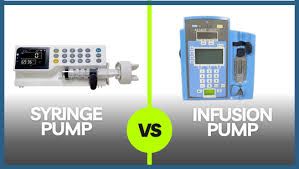
Syringe pumps are utilized for high precision, and for micro doses (microliters to milliliters), while infusion pumps require moderate precision, and are suitable for larger volumes (milliliters to liters). The flow rate range is narrower in syringe pumps compared to infusion pumps.
Reference
[1] Griffin, J. (n.d.). How do syringe pumps work? Ossila. https://www.ossila.com/pages/how-do-syringe-pumps-work
[2] CS/09 – GT1 Metrology in Health. (2018). Metrology in Health Good Practices Guide Part II. https://www.ordemfarmaceuticos.pt/fotos/qualidade/good_practices_metrology_in_health_guide_infusion_pumps_12797950485cb5de48431c1.pdf