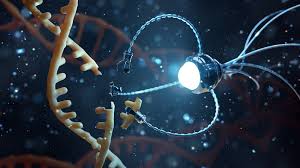
The human body contains coils and coils of DNA. The unwrapped DNA of a single cell would be around 2m long, and if you combine the length of all of them in our cells, it would be twice the diameter of the solar system.[1] For that single cell to hold so much information about the entire body’s machinery must mean that it requires something of a similar caliber for its treatment when it gets infected.
Traditional cancer treatment struggles with insufficient target accuracy and poor penetration into tumors. Nanorobotics is a rapidly developing field, and these nanobots can release drugs at the tumor site with high accuracy due to their small size.[2]
miRNA can be used as a cancer screening tool; therefore, one study used single-stranded DNA (ssDNA) with graphene-oxide (GO) coated gold nanowires, which are propelled by ultrasound, with high speed and sensitivity to miRNA, to diagnose breast cancer cells. When these nanomotors enter the cell, the dye-labelled ssDNA and GO bond interaction disappears, and the ssDNA binds with the miRNA instead, creating a fluorescent “switch” which turns off and on when the target is discovered.[3]
Nanorobots move autonomously, navigate the body precisely to reach the target site for the drug, preventing systemic toxicity effects of traditional treatment. They can also be monitored remotely, and the dose can be adjusted in real-time. Research led by Tang et al. developed highly biocompatible urease-actuated platelet cell robots, in which the urease catalyzes decomposition of urea into ammonia and carbon dioxide. This creates a concentration gradient and increases the speed of the nanobots to breast cancer cells. These robots were also self-propelled and offered strong, specific adhesion to the tumor cells.[4]
Some nanorobots merge both diagnostic and therapeutic strategies. A recent study focused on creating a microswimmer (microbots which can move in fluids), consisting of polydopamine (PDA) coating on magnetized spirulina. These are capable of spiral motion under a magnetic field, which can be detected in vivo via photoacoustic imaging. This can assist in diagnosing pathogenic bacteria in real-time, while the photothermal effect of PDA can be used to kill the bacteria.[5]
In certain cases, tumors have to be removed surgically, mostly in the early stages of development. It is only done when the tumor site is easily accessible and poses minimal risk of damage to adjacent healthy tissues. Nanobots, with their small size and high penetration power, enable the possibility of minimally invasive surgery. A microdrill that can reach up to a depth of 25 μm into a tissue, driven by an external magnetic field, has already been developed.[6]
Nanorobotics has achieved a great deal in the recent decade. However, there are still many challenges that need to be addressed to fully utilize its applications:
- Some of the fabrication technologies involved, such as 3D laser printing technology, are not suitable for mass production as they require specific materials and expensive instruments.
- Biohybridization is the combination of biological material with electronics or mechanical structure, and the technology utilized to produce such robots is limited by the types of biological materials available.
- The propulsion mechanisms used need to be optimized to achieve more precise control of motion direction and position, to navigate the complex biological environments. Intensity, frequency, and duration of externally applied fields also need to be within the range of biological safety.
Highly sensitive sensor systems and communication technologies suitable for small-scale are required for proper control mechanisms.[2]
Nanorobots still require ongoing research to resolve safety and biocompatibility issues, which will be the focus of further work. Future advancements in this field hold great potential for improving the treatment options, reducing side effects as well as enhancing the quality of life for patients.
References
[1]: Ashworth, H. (2024, July 1). How long is your DNA? BBC Science Focus Magazine. https://www.sciencefocus.com/the-human-body/how-long-is-your-dna
[2]: Qin, X., Xu, R., Wu, J., Liu, Y., Wang, T., Tu, H., Li, J., & Pang, Z. (2025). Recent advances in engineering nano/microrobots for tumor treatment. Acta Pharmaceutica Sinica B, 15(12), 6222–6252. https://doi.org/10.1016/j.apsb.2025.10.003
[3]: De Ávila, B. E., Martín, A., Soto, F., Lopez-Ramirez, M. A., Campuzano, S., Vásquez-Machado, G. M., Gao, W., Zhang, L., & Wang, J. (2015). Single Cell Real-Time MIRNAs sensing based on nanomotors. ACS Nano, 9(7), 6756–6764. https://doi.org/10.1021/acsnano.5b02807
[4]: Tang, D., Peng, X., Wu, S., & Tang, S. (2024). Autonomous nanorobots as miniaturized surgeons for intracellular applications. Nanomaterials, 14(7), 595. https://doi.org/10.3390/nano14070595
[5]: Xie, L., Pang, X., Yan, X., Dai, Q., Lin, H., Ye, J., Cheng, Y., Zhao, Q., Ma, X., Zhang, X., Liu, G., & Chen, X. (2020). Photoacoustic Imaging-Trackable magnetic microswimmers for pathogenic bacterial infection treatment. ACS Nano, 14(3), 2880–2893. https://doi.org/10.1021/acsnano.9b06731
[6]: Xi, W., Solovev, A. A., Ananth, A. N., Gracias, D. H., Sanchez, S., & Schmidt, O. G. (2012). Rolled-up magnetic microdrillers: towards remotely controlled minimally invasive surgery. Nanoscale, 5(4), 1294–1297. https://doi.org/10.1039/c2nr32798h