Introduction
Technologies in the healthcare industry are rapidly developing, particularly within the bounds of patient rehabilitation and mobility. Although hospitals used to be associated with the use of expensive medical technology, this has changed as healthcare institutions now adopt smart infrastructure to enhance treatment results.
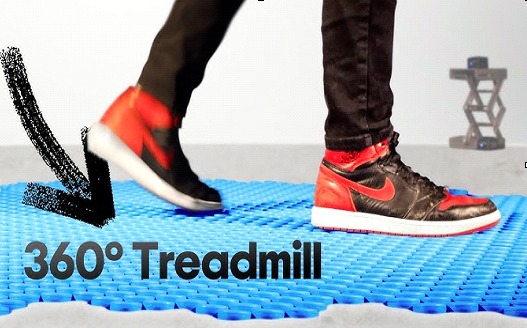
The Holotile Floor was initially created by Disney Research and Disney Imagineering as a virtual reality (VR) platform to allow multidirectional walking on a small physical area, which it did not want to limit to a single direction. In addition to entertainment and VR, this technology has a great potential in biomedical rehabilitation as it can be modified to gait training, balance training, and controlled movement therapy in a health care environment.
What Is a Holotile Floor?
A Holotile Floor is an intelligent, multi-directional flooring system meant to enable people to walk, turn and change direction instinctively in a limited area. It is also able to move in any direction as opposed to the traditional walking systems that leave the user on an uncontrolled surface that is prone to accidents. It is particularly applicable in rehabilitation facilities where space, security, and accuracy are very vital.
Constraints of the conventional Rehabilitation procedures
The traditional rehabilitation devices, including treadmills, are typically limited in a number of ways:
⦁ They are in favour of straight-line walking.
⦁ Balance and natural turning training is limited.
⦁ They need spacious physical places.
⦁ They might not entirely reproduce real life walking conditions.
Such restrictions may inhibit development of patients especially those that are recovering in terms of neurological or mobility disorders.
The use of Holotile Floor in Rehabilitation
The technology of Holotile Flooring will deal with these issues by allowing:
⦁ Directional changes and natural walking.
⦁ Regulated and secure rehabilitation programs.
⦁ Better training in balance and posture.
This renders it very appropriate when working with stroke survivors, individuals with neurological conditions, or patients with mobility limitations, in which case repetitive and lifelike movement training is the key to making patients feel better.
Healthcare Applications
Holotile Floor systems are applicable in:
⦁ Rehabs and physical therapy centers.
⦁ Balance and improvement programs (gait training).
⦁ Elderly care facilities
⦁ Intelligent hospital rehabilitation departments
This technology can also be used to provide real-time movement analysis and patient performance tracking when it is combined with sensors and digital monitoring systems.
Patient and Healthcare Provider Benefits
⦁ Rehabilitation solution of space efficiency.
⦁ Increased patient interaction and motivation.
⦁ Less risk of falls during training.
⦁ Better simulation of walking.
⦁ Possibility of greater recovery rates.
⦁ Smart Flooring in the Future of Healthcare.
With the current shift in the healthcare industry towards automation and smart systems, smart flooring such as the Holotile floor should be significant. Such technologies should be used to facilitate the transition to patient-centered, technology-based rehabilitation by integrating safety, realism, and adaptability.
Conclusion
The Holotile Floor is one of the promising new technologies in healthcare rehabilitation. It provides a contemporary alternative to the traditional rehabilitation practices, as it allows the movement in a safe and controlled environment which is multidirectional. Future advancement and incorporation can make this technology a strong asset of the healthcare institutions of the future.